Eastern subterranean termites remain the primary structural pest threat to residential architecture across Southern Maryland. In neighborhoods like Agricopia, Clarks Run, and Kings Grant, properties built over native…
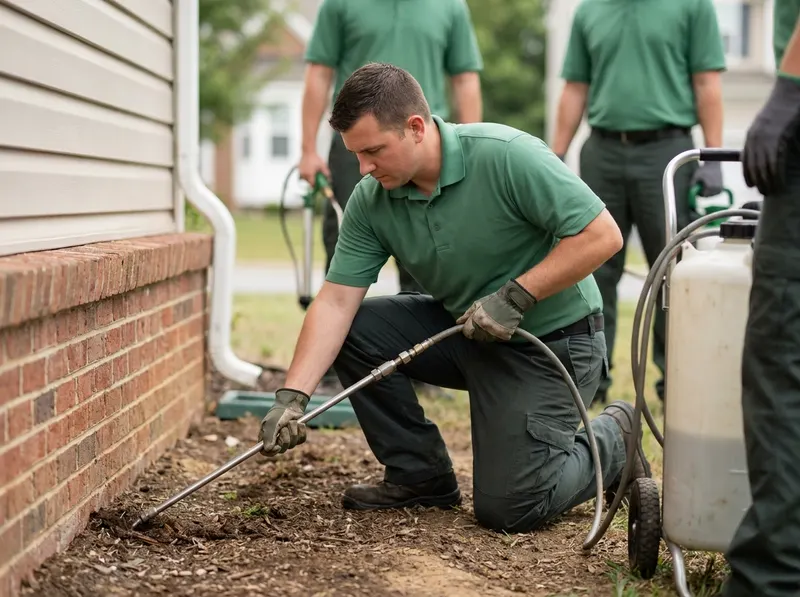
Eastern subterranean termites remain the primary structural pest threat to residential architecture across Southern Maryland. In neighborhoods like Agricopia, Clarks Run, and Kings Grant, properties built over native silt loam and clay subsoils experience dense subterranean moisture gradients that sustain massive colonial networks beneath the frost line. Worker termites exploit microscopic foundation settlement cracks, utility conduit entries, and brick veneer weep holes to reach structural framing components. Continuous soil treatments create an uninterrupted chemical envelope against foundation masonry, utilizing non-repellent termiticides that foraging workers unknowingly transport back to underground nest chambers, neutralizing the colony through natural social grooming behaviors.
Selecting a continuous liquid soil barrier over topical spot sprays or passive monitoring stations provides immediate, active structural interception. Spot applications leave untreated soil gaps that subterranean colonies navigate around, while bait systems require months of unassisted worker discovery before halting wood consumption. Homes located near damp topographies around Tilghman Lake Park or Wills Memorial Park require deep-injection trenching along crawlspace piers and exterior stem walls. This systematic barrier strategy halts active wood destruction without requiring multi-day household evacuations, preserving indoor air quality while reinforcing baseline structural integrity.
Every foundation profile across La Plata requires a measured chemical deployment calculated against specific building materials. Slab-on-grade homes in Hawthorne Green and Steeplechase often require precision sub-slab drilling along attached garage walls and expansion joints, whereas historic basements near the La Plata Train Station Museum require careful masonry rodding. Technicians calibrate liquid volume to guarantee 4 gallons of finished solution per 10 linear feet per foot of depth down to the footing. This scientific deployment ensures stable residual protection against subterranean moisture pathways without locking homeowners into mandatory ongoing monthly contracts.
Every job gets a firm, written price after a free on-site visit.
Tell us about your subterranean termite defense and soil treatment job in La Plata and we'll send a clear, written quote — usually the same day.
 Stonebridge Pest Defense Services